

Fursuit dance competitions are some of the most-watched events at any furry convention. At Anthrocon, the dance competition fills main stage seating to standing-room-only. At Midwest FurFest, competitors perform in front of thousands of cheering attendees. The crowd goes absolutely wild during a well-executed routine, and for many suiters, stepping onto that stage is the highlight of their entire convention.
The first thing most new competitors discover: dancing in a fursuit is nothing like dancing in street clothes. Your visibility drops dramatically (how much depends on your head design), your range of motion shrinks, and you are generating heat like a portable furnace. But the constraints are also what make fursuit dance so impressive to watch. When a performer nails a routine despite those limitations, the audience knows exactly how hard that was.
This guide takes you from "I want to try that" to walking off stage with a crowd roaring behind you.
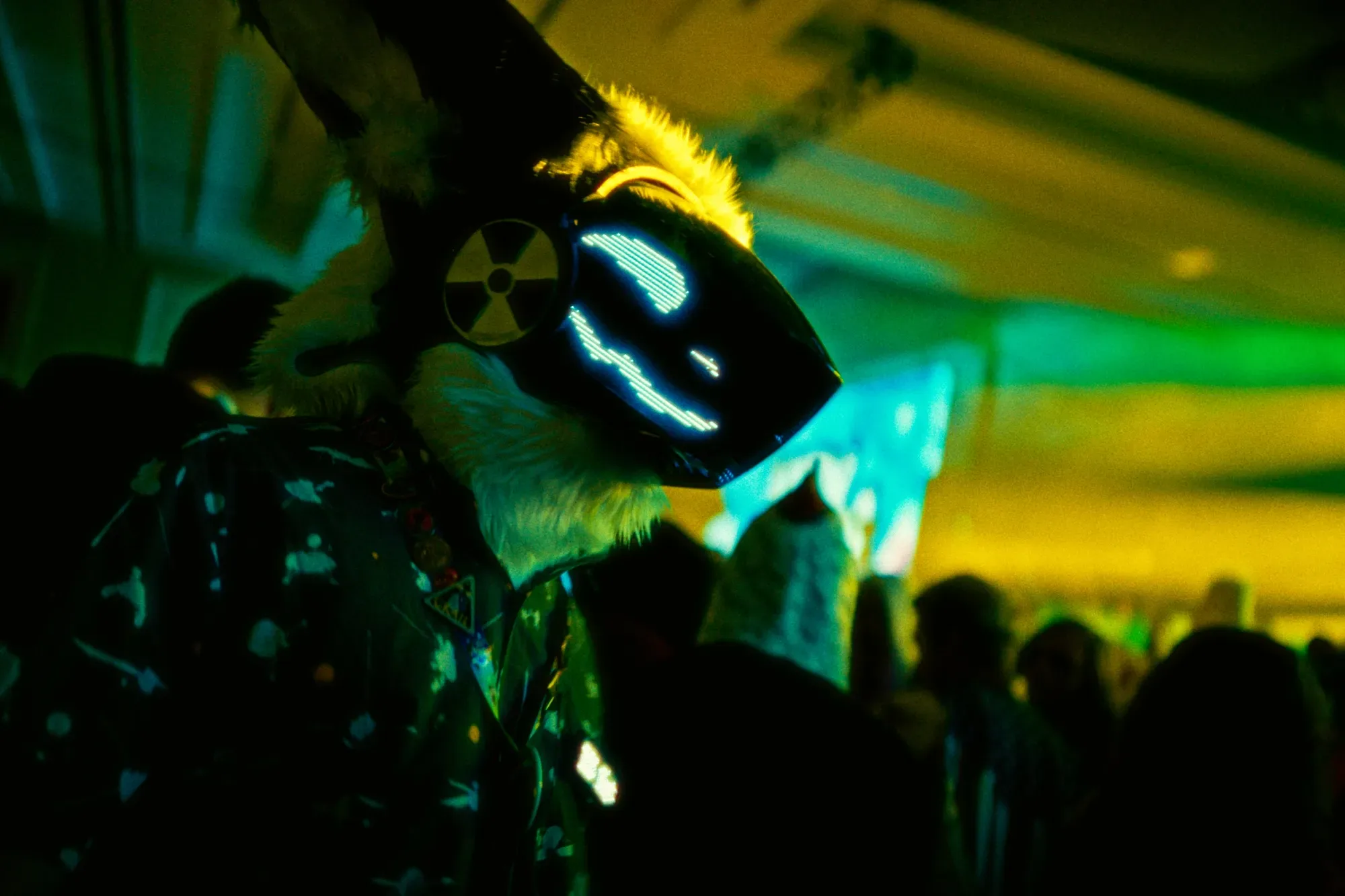
Dance floor at Midwest FurFest. Photo: @breonnick.bsky.social.
A fursuit dance competition is a stage performance event where fursuiters dance to a music clip of their choosing, judged on entertainment value, character expression, and audience response. Most conventions run them as part of their main events programming, often on a Saturday evening when attendance peaks.
Formats vary by convention, but the most common structures are:
Solo slots at the big conventions usually cap at two minutes, and Midwest FurFest allows up to 3:30. Plenty of competitors still trim to 60-90 seconds by choice, because a short routine with high energy consistently reads better than a long one that loses steam.
Not every convention runs a dance competition, but the ones that do treat it as a marquee event. These are some of the biggest and most competitive.
Anthrocon fills one of its largest ballrooms for the dance competition, with professional sound and lighting on a dedicated stage. The massive attendee pool attracts experienced performers from across North America, making it one of the most competitive lineups in the fandom.
Midwest FurFest runs both a structured dance competition and "Floor Wars," a bracket-style battle event with elimination rounds and audience judging. With over 16,000 attendees, the crowd energy is unmatched.
Furry Weekend Atlanta (FWA) hosts a popular dance competition with a dedicated performance space. The warm climate means competitors need to pay extra attention to heat management.
Eurofurence brings a European flavor to fursuit dance through its talent show and dance events. The international competitor pool tends toward more theatrical and character-driven routines compared to North American conventions.
Smaller regional conventions also run dance competitions and can be excellent places to get your first stage experience with lower pressure and equally enthusiastic audiences.
Registration processes differ by convention, but the general flow is consistent across most events.
Step 1: Check the schedule early. Registration often opens weeks before the convention through an online form. Popular events cap entries at 15-25 performers and fill up fast. Watch the convention's website and social media starting 4-6 weeks out.
Step 2: Submit your information. Most forms ask for your character name, a brief act description, and your music file. Some ask if you are entering solo or as a group.
Step 3: Prepare your music file. Conventions require a specific audio format (usually MP3 or WAV), trimmed to your exact performance length. Label the file clearly with your name and character name. Always bring a backup on a USB drive and have it on your phone as a last resort.
Step 4: Attend the performer meeting. Most conventions hold a brief meeting before the competition to cover stage layout, entry/exit paths, and last-minute rules. Missing it can disqualify you.
Typical requirements across conventions:
Your music choice shapes every other decision about your routine. Get this right, and the rest falls into place.
Go for a strong, clear beat. Fursuit movement is broad and exaggerated by nature. Songs with crisp, obvious rhythms let you hit beats the audience can see and feel. Subtle, complex rhythms get lost when your movements are filtered through padding and fur.
Match BPM to your suit's mobility. A 170 BPM drum-and-bass track sounds great until you try to keep up in a digitigrade suit with limited leg flexibility. Most successful routines use songs in the 100-130 BPM range. Faster songs work if you plan strategic pauses to contrast the speed.
Use dynamic shifts. Songs with a clear buildup, a drop, or a tempo change give you natural moments to surprise the audience. A sudden bass drop where you freeze, then explode into movement is the kind of moment that wins competitions.
You rarely need the full slot. Trim your track to the strongest section rather than filling every allowed second. A tight 75-second clip of the best chorus and bridge usually outperforms a meandering two-minute edit.
Submit clean versions only. Explicit lyrics will get your entry rejected at most conventions. If your song does not have an official clean version, you can edit it yourself or find an instrumental. When in doubt, go instrumental. Wordless tracks also prevent the audience from singing along instead of watching you.
Practicing your routine out of suit is a start, but it only gets you about halfway there. The gap between dancing in clothes and dancing in a fursuit is enormous.
Practice in your actual suit at least 5-6 full run-throughs. Not just the head. The full suit, including feetpaws, tail, and any padding. You need to know exactly how your suit changes your balance, your stride length, and your arm reach. Moves that look sharp in a mirror will look completely different through fur and foam.
Map your visibility. Put on your head and walk around your practice space. Most fursuit heads give you a narrow forward window through the eyes or mouth with zero peripheral vision. Learn to orient yourself using landmarks (the edge of the stage, the speakers, the judge's table) that you can spot through your limited field of view.
Exaggerate everything. Small, precise movements disappear inside a fursuit. A subtle hand gesture becomes invisible. A small hip sway vanishes under padding. Raise your arms higher. Swing wider. Point harder. What feels ridiculous without the suit reads as "normal" to the audience in full fur.
Time your heat window. Do a full suit-up and run through your routine with a timer. Note when you start sweating heavily and when you hit the "I need to stop" point. That number is personal to you and to your suit, and the 90 seconds on stage is only part of it: the backstage wait, in suit, under lights, is what actually eats the window.
Record yourself. Film your practice runs in suit. The playback will reveal problems you cannot feel from inside: a tail that swings awkwardly, arm movements absorbed by the bodysuit, or moments where you drift off the beat.
For a deeper look at visibility and safety while performing, check out our fursuiting essentials guide.

Judging criteria vary by convention, but most dance competitions score on four core pillars.
Energy and stage presence. Judges want to see a performer who owns the stage. Confident movement, deliberate positioning, and an overall vibe that says "I belong here" scores higher than technical perfection delivered timidly. Fill the space. Use the whole stage.
Character portrayal. Your fursuit is a character, and the best competitors dance as that character. A goofy cartoon wolf should move differently than an elegant fox. Judges notice when a performer's movement style matches their character's personality. Lean into your character's vibe and let it shape your routine.
Crowd engagement. The audience is part of your performance. Pointing at the crowd, encouraging cheers, reacting to their energy, and making eye contact (as much as a fursuit allows) all boost your score. Performers who dance at the audience rather than for themselves consistently place higher.
Creativity and originality. Surprise the judges. An unexpected move, a clever use of your suit's features (articulated jaw, moving ears, LED eyes, a tail flip), or a moment that makes the audience gasp or laugh will stick in a judge's memory. You do not need to reinvent dance. You need one or two moments that nobody else in the lineup delivers.
What judges are NOT looking for: Perfect choreography, professional dance training, or complex acrobatics. A suiter with zero formal dance experience who brings infectious energy, great character work, and a crowd on their feet will outscore a trained dancer who delivers a technically clean but emotionally flat routine every time.
A fursuit dance performance is a sprint inside a personal sauna. Your body needs to be ready.
Hydrate starting 24 hours before the competition. Not just the hour before. Drink water consistently throughout the day before the event. By the time you feel thirsty in suit, you are already behind on hydration.
Use a cooling vest if you have one. Evaporative or ice-pack vests make a real difference during extended time in suit. Put it on before you suit up, and make sure it is properly chilled or soaked. Our cooling solutions guide covers both budget and premium options.
Eat a light meal 2-3 hours before performing. You need fuel, but a heavy meal will make you sluggish and nauseous in a hot suit. A banana, some crackers with peanut butter, or a light sandwich works well. Avoid dairy and greasy food.
Warm up out of suit. Do some light stretching and a few minutes of easy movement before you start suiting up. Cold muscles plus sudden exertion inside a hot fursuit is a recipe for cramps.
Assign a handler. Your handler is your safety net. They should know your "I need out" signal (a specific gesture, a tap pattern, a verbal cue). They should know the location of the nearest headless lounge, have water ready for you the moment you come offstage, and be prepared to help you de-head quickly if you overheat. Do not compete without one.
These are the pitfalls that knock first-time competitors out of the running.
Trying to do too much. A routine packed with nonstop fast moves will drain you in 30 seconds and leave the remaining minute looking sluggish. Build in deliberate pauses, slow moments, and poses. Contrast makes the high-energy moments hit harder.
Not testing your music at volume. Your headphones sound different from a convention PA system. Bass-heavy tracks can become muddy through venue speakers, and quiet intros might be inaudible over crowd noise. Ask the A/V team for a quick sound check during the performer meeting if possible.
Ignoring the audience. Dancing with your back to the crowd, staring at the floor (or where you think the floor is), or performing entirely inward makes you forgettable. Even if you cannot see the audience clearly, face them. React to their cheers. Give them reasons to cheer louder.
Wearing a suit you are not comfortable in. If your suit restricts your breathing, pinches when you raise your arms, or has feetpaws you trip over, do not compete in it until those issues are fixed. The adrenaline of a live performance amplifies every discomfort.
Skipping the performer meeting. The meeting tells you which side of the stage you enter from, where the cables are, and any last-second rule changes. Skipping it puts you at a serious disadvantage.
Not having a backup plan for your music. Flash drives fail. Convention Wi-Fi collapses under 10,000 simultaneous connections. Bring your music on a USB drive, have it on your phone, and email it to yourself. Redundancy saves routines.
Not sure which conventions near you run dance events? Browse our full convention calendar to find events in your area and check their programming schedules. Our guide to fursuit-friendly conventions also highlights which events offer the best infrastructure for performers, including stage quality, backstage cooling, and handler support.
Browse our complete calendar with dates, locations, and details for every upcoming furry convention.
View Full CalendarNo. Fursuit dance competitions reward entertainment value, character expression, and crowd engagement over technical skill. Many winners have no formal dance training. If you can move to a beat, commit to your character, and bring energy to the stage, you have a real shot. Start at a smaller regional convention where the pressure is lower.
Songs with a strong, clear beat in the 100-130 BPM range work best for most fursuiters. Look for tracks with dynamic shifts like buildups, drops, or tempo changes that give you natural moments for dramatic moves. Instrumental tracks or songs with minimal vocals tend to keep the audience focused on your performance rather than the lyrics. Always submit a clean version with no explicit content.
Solo slots at the big conventions usually cap at two minutes, and Midwest FurFest allows up to 3:30, but you do not have to use all of it. Shorter, high-energy routines consistently score better than longer ones that lose momentum. Trim your music to the strongest 70-80 seconds of the track and build your routine around that window. Every second should earn its place.
Requirements vary by convention. Most dance competitions require at minimum a head and handpaws, and many prefer a full partial (head, handpaws, tail, feetpaws) or full suit. Check the specific rules for your convention's competition. Partial suits do offer a mobility and cooling advantage, so if they are allowed, you can use that freedom to deliver a more energetic routine.
Hydrate heavily the day before and the day of, wear a cooling vest under your suit, and eat a light meal a few hours before performing. Wait to put on your head until close to your slot to minimize active suit-up time. Have your handler standing by with water and a fan for the moment you come offstage. If you feel dizzy or nauseous, stop immediately. No placement is worth a medical emergency.

Master fursuit photography at conventions with practical camera tips, lighting advice, gear picks, and the consent etiquette every photographer must follow.

Anthro New England 2026 recap: a record 7,284 attendees, $50,000 split between Wings Wildlife and Queer Scouts, and a 2027 venue expansion.

Anthro Northwest 2026 recap: a record 3,466 attendees, a Sarvey Wildlife partnership, a "Nature" theme, and a New Year's weekend at the Hyatt Regency Seattle.