

This guide covers nine furry conventions across Japan, Taiwan, China, South Korea, Australia, Malaysia and Singapore. Most of the year's Asia-Pacific calendar has already run: JMoF, FurryJoA, FurDU, MYFurCon, Furrymosa and Little Island Furcon are behind us, while Infurnity and Kemocon are still ahead in late October and November.
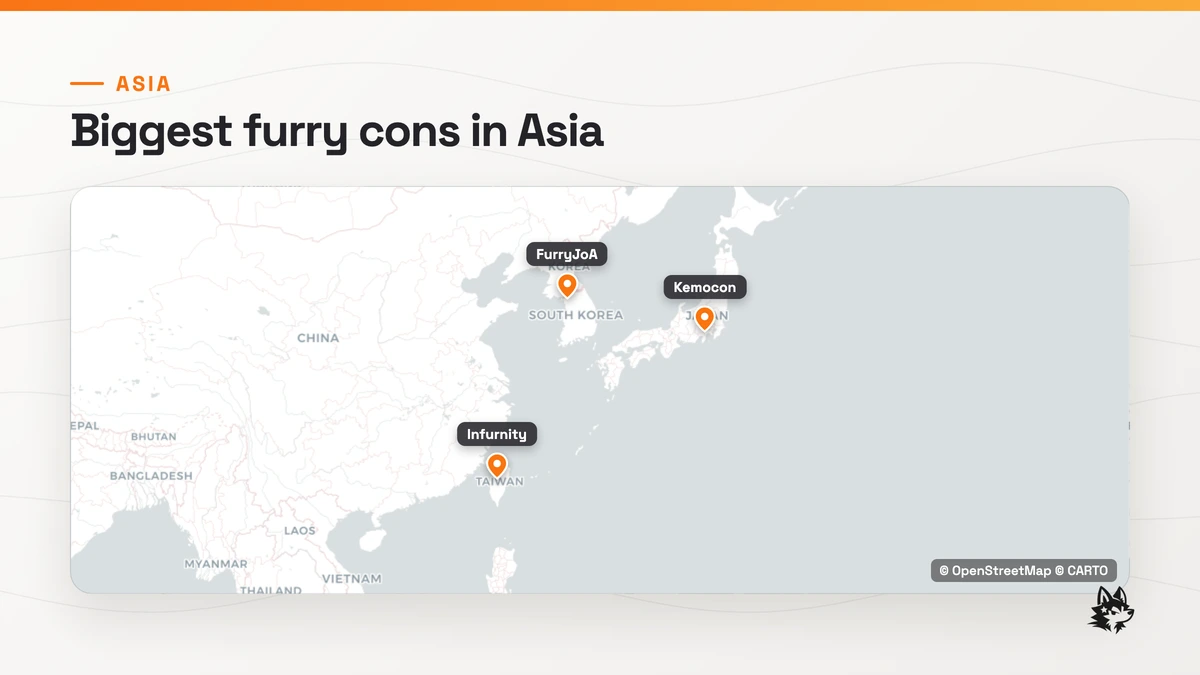
FurryJoA, Kemocon and Infurnity on one map of East Asia.

JMoF is the largest dedicated furry convention in Japan and the primary gathering point for the Japanese kemono community. The January 2026 edition, themed "Ocean's Furteen," drew 2,524 participants and raised ¥5,229,650 for Toyohashi Zoo and Botanical Park (Nonhoi Park). Guest of Honor Kenji Watanabe headlined a weekend of teamwork-oriented programming and "casino" style game events at the Loisir Hotel Toyohashi in Aichi Prefecture. Many fursuiters performed choreographed stage acts. Character performance and suit acting carry more weight at Japanese events than at Western ones. The art gallery, dealers room, dance events, and panels covered both Japanese kemono culture and international furry fandom. For 2027 the convention leaves Toyohashi for Aichi Sky Expo on the Centrair airport island in Tokoname, a short walk from the arrivals hall of Chubu Centrair International Airport (NGO).

Kemocon takes place at the Toki no Sumika resort in Gotemba, a town at the base of Mount Fuji in Shizuoka Prefecture, with clear-day views of Fuji from the venue area. The convention reported 4,286 cumulative attendees across its three days in 2025, a daily total rather than a unique headcount. The resort format creates a more relaxed, retreat-like atmosphere than JMoF, with a focus on socializing, outdoor activities, and the natural surroundings. Programming tends to be lighter, with fewer structured panels and more open social time. Gotemba is accessible by bus from Tokyo (about 90 minutes) or by local train lines. The nearby Gotemba Premium Outlets and surrounding hot spring resorts give attendees options for non-convention activities.

Infurnity is the largest furry convention in Taiwan and one of the most internationally welcoming events in the Asia-Pacific region. The 2026 edition runs with a post-apocalyptic "The Last of Furs" theme, inspired by The Last of Us, at the Fullon Hotel Lihpao Land. Taichung is Taiwan's second-largest city by population, reachable by high-speed rail from Taipei (about 50 minutes) or by direct flights to Taichung Airport from several Asian hubs. Infurnity provides English-language support at registration, in programming materials, and through bilingual volunteer staff. The dealers room draws Taiwanese, Japanese, and international artists. Taichung's night markets sell everything from grilled squid to bubble tea, and attendees often explore them after convention hours. The 2025 edition, themed "Furtopia," drew 3,251 attendees.
Furrymosa is not a hotel convention. It is a one-day furry doujinshi sales fair modeled on Japan's Kemoket, and its eighth edition on June 6, 2026 filled the Sanchong Sports Center Exhibition Hall with about 150 vendor circles. As a marketplace, it has no annual theme and no guest of honor, and it has not published an attendance figure for 2026. Go if you want to buy fan-made books and merchandise from Taiwanese creators in one afternoon. New Taipei City is on Taipei's MRT network, so it combines easily with sightseeing in Taipei proper.
Winter Furry Fusion is the December event of the Furry Fusion family in Shanghai. Its summer sibling, Super Furry Fusion, is the larger of the two. WFF does not publish attendance figures, so treat any number you see quoted for it with caution. Shanghai is one of the most internationally accessible cities in China, with direct flights via Pudong International Airport (PVG) and Hongqiao Airport (SHA). The event is a hotel fursuit meet with suit performances and social events. Shanghai's metro system is extensive and affordable. Keep in mind that Western social media platforms and messaging apps (Twitter, Discord, Telegram) need a VPN in China, so set that up before you arrive.

FurryJoA is a two-day convention in Goyang, on the northwest edge of Seoul. The 2026 edition ran under a "Magic and Fantasy" theme and the convention's own post-con credits post put attendance at 2,193, a little below the 2,372 it reported for 2025. The organizer has since announced February 27-28, 2027 on its X profile.

FurDU is held at the Crowne Plaza in Surfers Paradise on the Gold Coast. Its 2026 edition, "Beyond the Beach," raised money for WildLife Empire, the same charity it supported in 2025, when it drew 2,086 attendees. No 2026 headcount has been published yet. The 2027 edition, "Enchanted Forest," runs 16 to 18 April 2027 at the same hotel.

MYFurCon is Malaysia's newest convention. Its first edition ran for one day on May 2, 2026 and was reported at 500 attendees and 160 fursuiters. The second edition moves to a two-day format at Hotel Armada Petaling Jaya on April 24-25, 2027, under a "FurGear" theme.

Little Island Furcon is Singapore's convention. The 2026 edition, "Mission Impawssible," raised S$6,020.21 for Mercylight Animal Rescue And Sanctuary. No headcount for 2026 has been published yet; the 2025 edition reported 350 attendees.
Two of these conventions have fixed their 2027 dates. JMoF runs January 8-10, 2027 at Aichi Sky Expo in Tokoname, and MYFurCon runs April 24-25, 2027 at Hotel Armada Petaling Jaya. The rest have not announced yet. Our 2027 furry convention calendar adds dates as conventions publish them.
If you are bringing a fursuit on an international trip for the first time, our international travel guide for fursuiters covers insurance, customs paperwork, and airline policies in detail.
Round-trip flights from the US West Coast to Tokyo typically range from $600 to $1,100 in economy. From the US East Coast, expect $800 to $1,300. Flights to Taipei are in a similar range. Shanghai can sometimes be cheaper, with fares from $500 to $900 from the West Coast. Booking 3-4 months in advance and being flexible on travel dates (mid-week departures) helps significantly. Intra-Asian flights between Tokyo, Taipei, and Shanghai are relatively affordable at $150-350 round-trip on carriers like Peach, Scoot, or China Eastern.
Japan is the most expensive destination for accommodation. Budget hotels near convention venues in Toyohashi or Gotemba run $60-100 per night. Business hotels in larger Japanese cities (Tokyo, Osaka) range from $80-150. In Taiwan, hotel rates are lower: $40-80 per night for a comfortable hotel in Taichung or Taipei. Shanghai runs from $30 budget options to $120 mid-range hotels near the city center. Sharing rooms with other convention attendees is common and helps offset costs.
Japan's food costs are moderate by Western standards: a restaurant meal is $8-15, and convenience store meals (surprisingly good quality) are $3-7. Taiwan is one of the most affordable food destinations in Asia, with night market meals costing $2-5 and sit-down restaurants at $5-12. Shanghai is similarly affordable for food. Local public transport in all three countries is cheap and reliable: metro rides cost $1-3, and intercity trains or buses are the most practical way to move between airports, cities, and convention venues.
Prices are set in local currency and differ a lot from con to con. JMoF's 2027 adult membership for all three days is ¥18,000, with cheaper rates for under-20s and one-day tickets. Kemocon's 2026 Member pass is ¥5,000 and its Supporter pass ¥12,000. Infurnity's 2026 attendee ticket is NT$1,500, and Furrymosa charges NT$200 at the door. Check each convention page for the current ladder. For a full breakdown of how to plan your convention budget, see our con budgeting guide.
If you are attending an Asian furry convention for the first time, understanding the differences between kemono and Western furry culture will help you get the most out of the experience.
Kemono-style fursuits tend to have a more stylized, anime-influenced look with larger eyes, smoother facial proportions, and more compact body shapes. Western fursuits often aim for a broader range of styles, from toony to realistic. At conventions like JMoF, you will see a high concentration of kemono-style suits, and the craftsmanship is often focused on refined detail and performance capability rather than size or complexity.
Japanese conventions tend to be quieter and more structured than Western events. Attendees generally follow queue lines precisely, keep noise levels moderate in common areas, and treat photography with more formality. It is considered polite to ask before photographing someone's fursuit, and many suiters carry business cards (meishi) with their character name and social media handles. Exchanging these cards is a common interaction.
Stage performances at Asian conventions, particularly JMoF and Kemocon, are often choreographed and rehearsed to a high standard. Suit acting is treated as a performing art, with an emphasis on character expression through movement. This differs from many Western conventions where fursuit events are more casual or comedy-oriented.
At Japanese conventions, English is not always widely spoken among attendees, though staff often have some English capability. Having a translation app ready and learning basic Japanese greetings (konnichiwa, sumimasen, arigatou) goes a long way. Taiwanese conventions tend to have more English speakers, particularly among younger attendees. At Chinese events, Mandarin is the primary language, and having offline translation tools is practically essential.
Tipping is not practiced in Japan and can actually cause confusion or discomfort. In Taiwan, tipping is uncommon except at high-end restaurants. In China, tipping is not expected. Cash is still important in Japan (many smaller shops and restaurants do not accept cards), while Taiwan and China have embraced mobile payment systems (Line Pay, Apple Pay in Taiwan; WeChat Pay and Alipay in China, though these require local bank accounts to set up).
Japan and Taiwan offer visa-free entry for citizens of most Western countries for short tourist stays. China's rules now vary a great deal by passport, with some nationalities visa-free for short stays and others needing a visa in advance. Check your country's specific requirements with the relevant embassy, as visa policies change.
The JMoF registration process is primarily in Japanese, but community-created English guides are typically shared on social media (particularly Twitter/X and Telegram) before registration opens. Browser translation tools work reasonably well for the registration forms. Some years, JMoF has provided limited English instructions. Join English-language JMoF community groups online for step-by-step guidance.
Absolutely. Western-style fursuits are welcomed at Asian conventions, and many attendees enjoy seeing the variety of international suit styles. There are no rules restricting suit types. You may attract extra attention and photo requests because your suit style will stand out among the predominantly kemono aesthetic.
Yes, this autumn. Infurnity ends November 1 in Taichung and Kemocon starts November 6 in Gotemba, so a Taiwan-to-Japan double fits in about ten days. Flights between Taipei and Tokyo take about 3-4 hours on budget carriers. JMoF in January is too far from either for a single trip.
In Japan and Taiwan, convention venues and hotels typically have Wi-Fi, and you can rent a pocket Wi-Fi device or buy a local SIM at the airport for reliable mobile data. In China, be aware that Google services, Discord, Twitter, Telegram, and many Western websites are blocked by the Great Firewall. Download and configure a VPN before entering China, and download offline maps and translation packs in advance.
Browse our complete calendar with dates, locations, and details for every upcoming furry convention.
View Full CalendarSources

Eurofurence (9.1K), NordicFuzzCon, ConFuzzled, Scotiacon, Gdakon and Fauntastic: 2026 results, 2027 dates, visa and fursuit travel tips for Europe.

Cold-weather fursuiting tips for winter furry conventions: flight disruption, packing checklists, battery care in freezing temps, salt protection.

Not sure which furry convention to attend first? We rank the most beginner-friendly cons by size, cost, and community vibe to help you pick your first.